Imagine this scenario: You finally decide to invest in a gemstone. You have done your research, you have saved up, and you are holding a beautiful Emerald or a Ruby in your hand. You bring it close to your eye, squinting under the light, and then—you see it.
A tiny black speck. A faint wisp that looks like a feather. A cloudy patch in the corner.
Your heart sinks. “Is this a defect?” you wonder. “Did I just buy a damaged stone?”
At Vibes & Co., we hear this concern often. In a world obsessed with airbrushed photos and perfect filters, we have been conditioned to believe that “flawless” equals “better.” But when it comes to gemstones, the opposite is true.
If you are holding a stone that is completely clean, perfectly transparent, and devoid of any internal marks, you should probably be worried. It might not be a rare gem; it might just be a very expensive piece of glass.
Here is why those little imperfections—or as we call them, inclusions—are actually the best thing you can find in your gemstone.
The Myth of Perfection: Why “Flawless” is Suspicious
Let’s talk about how gemstones are made. A natural gemstone is cooked up by Mother Earth over millions of years. It forms deep underground under intense heat, crushing pressure, and chaotic geological shifts. During this violent process, other minerals, gases, and water get trapped inside the crystal as it grows.
These trapped elements become inclusions. They are nature’s fingerprints. Just as no two humans have the same fingerprint, no two natural gemstones have the exact same pattern of inclusions.
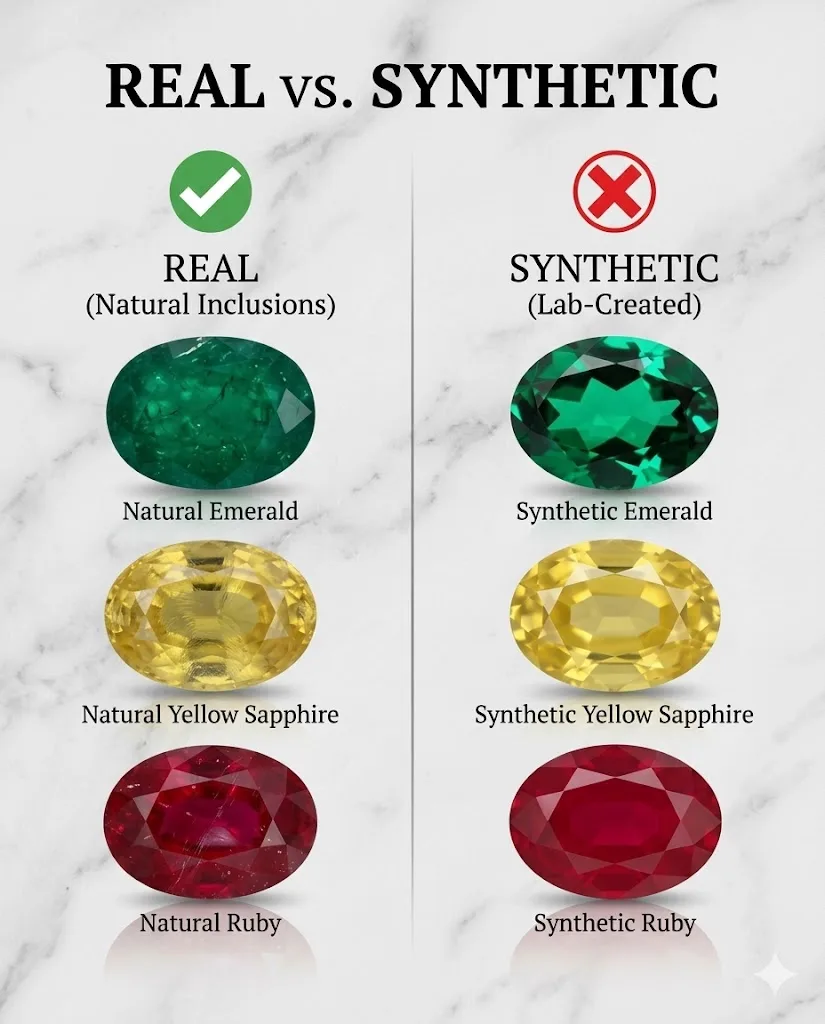
On the other hand, synthetic stones or glass imitations are made in a factory. They are created in controlled, sterile environments. The result? They look too perfect. They are eerily clean, like a piece of hard candy.
Unless you are buying a diamond worth millions of dollars, a “perfectly clean” stone is the biggest red flag in the gem trade. When you see an inclusion, you are seeing proof that the stone is earth-mined, not mass-produced.
The Emerald Test: Understanding the “Jardin”
Nowhere is this concept more important than with Emeralds (Panna).
If you look closely at the Emeralds in our collection at Vibes & Co., you will notice they aren’t clear like green water. They have character. They have internal features that look like tiny mossy branches, vines, or jagged ice.
Gemologists have a beautiful name for this: The Jardin (French for “Garden”).
A natural Emerald almost always has a Jardin. It is a sign that the stone is genuine. In fact, the Jardin is so accepted in the gem world that it doesn’t necessarily lower the value of the stone the way a black spot might in a Diamond. It confirms the stone’s identity.
If someone tries to sell you a Panna that looks like a clear green bottle of Sprite with zero internal “garden,” be very careful. It is likely a synthetic emerald or colored glass. By embracing the Jardin, you are embracing the authenticity of the stone.
Why It Matters for Astrology: The Energy Connection
For our customers who buy gemstones for astrological remedies (Jyotish) or spiritual healing, authenticity isn’t just about value—it’s about vibration.
The entire premise of crystal healing is that gemstones act as capacitors for energy. They have absorbed the earth’s magnetic fields, solar radiation, and geological energy for millions of years. This accumulated energy is what interacts with your bio-field (aura) to bring about shifts in luck, health, or mood.
Synthetic stones have no history. A lab-created ruby has the same chemical composition as a natural one, but it was grown in a microwave-like chamber in a few weeks. It hasn’t “lived.” It is an empty vessel.
Glass and plastic are even worse; they are energetic insulators. They block energy rather than conduct it.
When you see a natural inclusion in your Yellow Sapphire or your Ruby, remind yourself: “This mark was made by the Earth 50 million years ago.” That is the connection that fuels the astrological remedy.
The Vibes & Co. Promise: Transparency in Every Stone
At Vibes & Co., we don’t hide the truth about our stones; we celebrate it. We believe an informed customer is a happy customer.
When you shop with us in Pune or online, we encourage you to look deep into the stone. We want you to see the silk in the Sapphire and the garden in the Emerald. These aren’t flaws; they are birthmarks.
However, we also understand that you need more than just a visual check. That is why we stand firmly on the pillar of Certification.
- We source ethically mined stones.
- We provide third-party lab certification for our premium gemstones, which clearly states “Natural” on the report.
- We walk you through exactly what you are buying, explaining the difference between a natural inclusion and a surface crack (which is a defect to avoid).
Final Thoughts
The next time you are shopping for jewelry and you spot a tiny internal speck in a stone, don’t recoil. Lean in. You are looking at nature’s signature—a guarantee that what you are holding is rare, real, and ready to work for you.
Don’t settle for glass. Invest in earth-mined, certified gemstones that carry real energy.